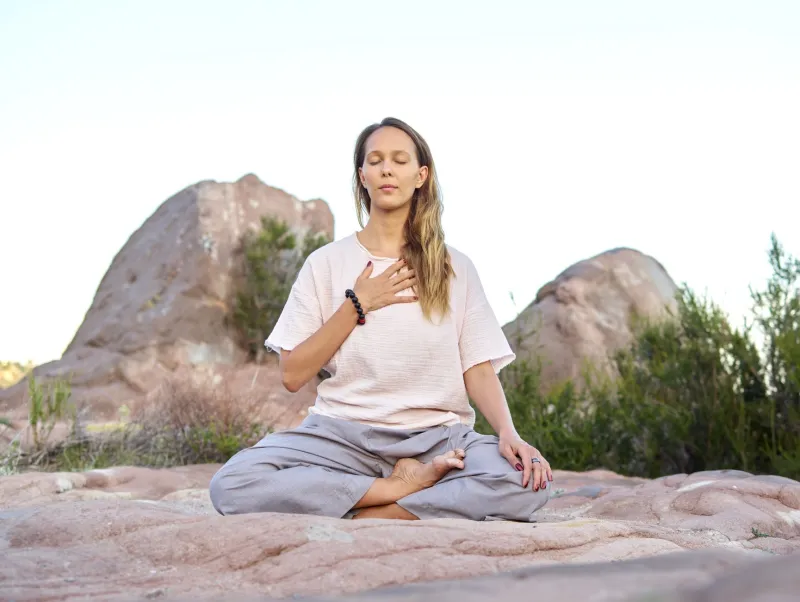
When Your Hormones Shift, So Does Your Practice: A Trans Guide to Spiritual Adaptation During HRT

Photo by Photo by Vitaly Gariev on Unsplash on Unsplash
The first few weeks on estrogen, Maya Rivera noticed something strange during her morning meditation. The sessions she'd been doing for six years suddenly felt different — looser, more emotionally textured, occasionally overwhelming in the best possible way. "It was like the volume knob on my inner life got turned up," she says. "I had to completely rethink how I sat with myself."
Maya isn't alone. Across trans communities, people navigating hormone replacement therapy describe profound shifts not just in their bodies but in how they experience spiritual practice. Meditation feels altered. Breathwork lands differently. The energetic map they'd been using suddenly needs updating.
This isn't a crisis. In many dharmic traditions, it's actually an invitation.
The Body as a Living Practice Space
Dharmic traditions — including Hindu, Buddhist, Jain, and Sikh lineages — have always understood the body as more than a container for the soul. It's an active participant in spiritual life. Prana, the life-force energy central to yogic and Ayurvedic frameworks, flows through a system that responds to everything: sleep, food, stress, relationships, and yes, hormones.
When you introduce exogenous hormones or blockers, you're not just changing your biology. You're shifting the conditions through which prana moves. That's significant — and it's worth approaching with curiosity rather than alarm.
Ayurvedic practitioners sometimes describe hormonal shifts as a change in dosha dominance. Estrogen-based transitions can increase qualities associated with kapha — heaviness, receptivity, emotional depth — while testosterone-based transitions may amplify pitta and vata energies: drive, heat, sometimes volatility. These aren't rigid rules, and Ayurveda wasn't designed with trans bodies in mind. But the framework offers a useful vocabulary for noticing what's actually happening.
"I started thinking of early T as a pitta surge," says Darius Okafor, a nonbinary practitioner based in Atlanta who began testosterone therapy three years ago. "Everything felt sharper, more intense. My old yin yoga practice wasn't meeting me where I was anymore. I had to move."
What Practitioners Are Actually Experiencing
The changes people report during HRT aren't uniform, but some themes come up again and again.
Emotional accessibility is one of the big ones for people on estrogen. Crying during meditation, feeling more porous to others' energy, experiencing devotional practices — kirtan, prayer, visualization — with new intensity. This can be disorienting if your practice was built on a foundation of detachment or cool observation.
Energy and stamina shifts are common across both estrogen and testosterone transitions, especially in the first year. Some people find early-morning practice suddenly impossible; others discover new windows of clarity they didn't have before.
Breath patterns change, too. Several practitioners we spoke with noted that pranayama — yogic breathwork — felt physically different after hormonal shifts affected lung capacity, vocal resonance, or emotional regulation. Some found certain techniques (like kapalabhati, or skull-shining breath) too activating during emotionally raw phases of transition. Others found breathwork became a new anchor.
The inner critic gets weird. Dysphoria and spiritual self-judgment can tangle in unexpected ways during transition. Practices that involve body-based visualization or chakra work (like imagining energy moving through specific physical locations) can surface discomfort if your relationship to your body is in active flux.
Adapting Without Abandoning
The good news? Dharmic traditions are full of tools for working with change rather than against it.
Follow the energy, not the schedule. Rigidity in spiritual practice can become its own obstacle. If your 6 a.m. sitting meditation isn't working right now, experiment. Evening practice, walking meditation, or even short check-ins throughout the day can maintain continuity without forcing a structure your body is actively resisting.
Lean into devotional practices during emotional amplification. If estrogen has made you more emotionally open, that's not a bug — it might be a doorway. Bhakti practices (devotional chanting, prayer, offering) are specifically designed to work with the heart rather than around it. Let the feelings be the practice.
Explore movement-based traditions during high-energy phases. When testosterone brought Darius a restless, kinetic energy, he found his way to a Kundalini yoga class. "The kriyas gave me somewhere to put all that intensity. I wasn't fighting my body anymore — I was working with it."
Be honest with your teachers. If you practice with a teacher or in a community, you don't have to share every detail of your transition, but letting someone know your practice needs are shifting can open doors. A good teacher will adapt with you.
Consider working with an Ayurvedic practitioner or integrative health provider who has experience with trans bodies. Increasingly, these practitioners exist — and they can help you think about diet, sleep, and routine in ways that support both your transition and your spiritual life.
Consistency Doesn't Mean Sameness
One of the quieter fears that comes up for trans practitioners during HRT is the worry that they're somehow failing their practice — that a "real" meditator would sit through the discomfort unchanged. This is worth pushing back on directly.
Consistency in spiritual practice isn't about doing the same thing every day forever. It's about maintaining the intention to meet yourself honestly. Transition, by its very nature, asks you to do exactly that. The willingness to say "I am different today than I was yesterday, and I want to understand that" — that is the practice.
Maya, who now teaches meditation to other trans folks in her Chicago community, puts it simply: "I used to think I had to protect my practice from my transition. Now I understand that my transition was my practice all along."
The path doesn't disappear when the terrain changes. Sometimes it just gets more interesting.